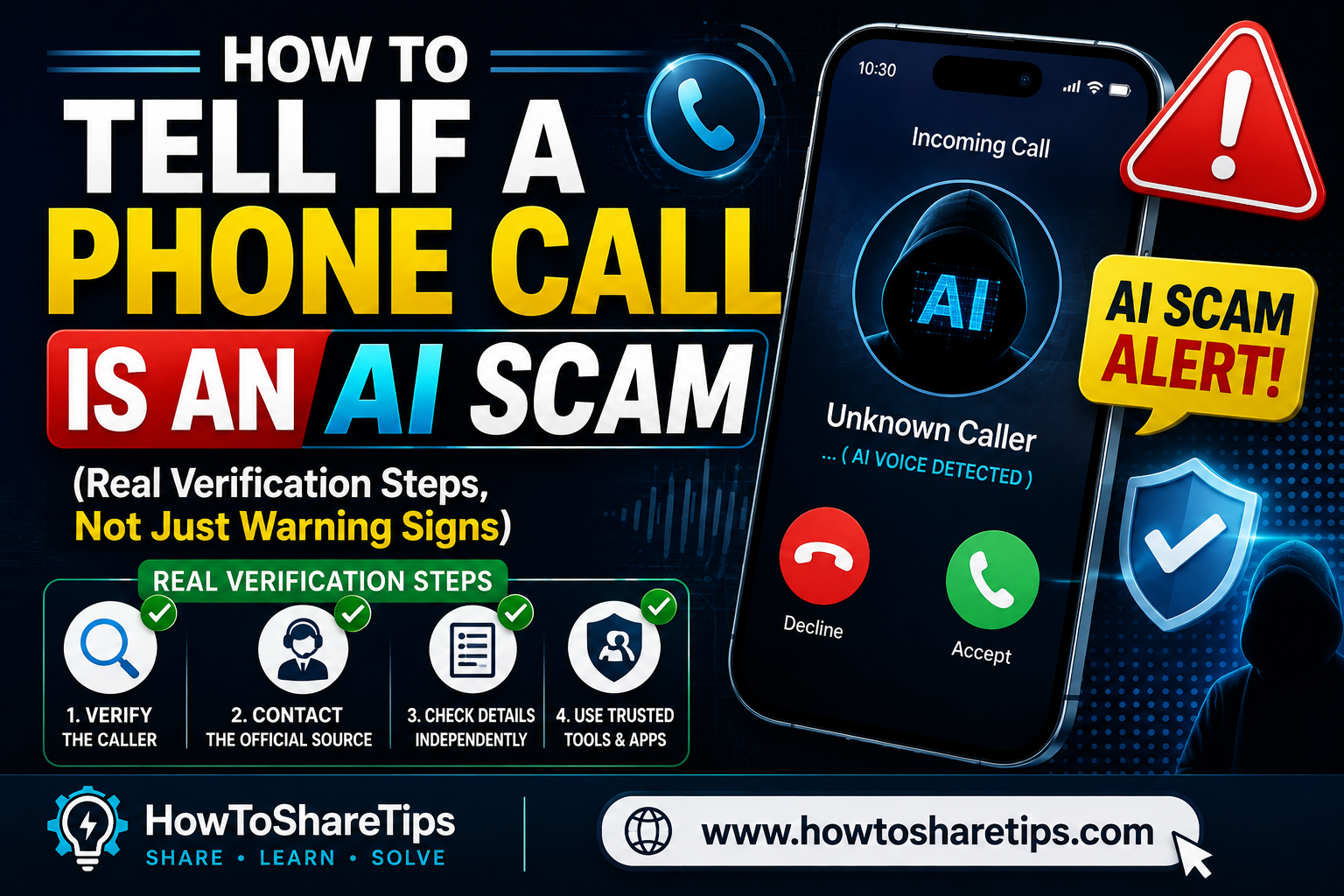
Your phone rings. It’s your daughter. Her voice is shaking. She says she’s been in a car accident, she’s scared, she needs money right now, and please don’t call anyone else because the police are already handling it and it will only complicate things.
Except it isn’t your daughter. It’s three seconds of her voice, pulled from a TikTok clip or a voicemail greeting, run through an AI voice cloning tool that costs less than a coffee subscription. The panic in her tone, the crying, the urgency, all of it was generated to make you stop thinking and start acting.
This is not a rare, futuristic scenario anymore. It’s happening to ordinary families and small businesses every single day in 2026, and the tools that make it possible have become so cheap and so good that “just trust your gut” is no longer good advice. Your gut was built to detect a stranger’s voice sounding off. It was never built to detect a voice that sounds exactly right but is being used in the wrong way.
So the real question people are typing into Google right now isn’t “what is a deepfake.” It’s much more practical than that. It’s “how do I actually check if this call is real,” asked in the middle of a moment when their hands are shaking and they have thirty seconds to decide. This article is built to answer that exact question, with a step by step process you can actually use, not just a list of red flags to memorize and hope you remember under pressure.
Why This Is Suddenly Everywhere
A few years ago, voice cloning required minutes of clean audio and expensive software. Today, three to ten seconds of someone’s voice, pulled from a social media video, a podcast appearance, a voicemail greeting, or even a work Zoom call, is enough to produce a convincing clone. Surveys from companies like Starling Bank and Hiya have found that roughly one in four adults believe they’ve already been targeted by a voice cloning attempt.
According to Sumsub’s identity fraud research, sophisticated identity fraud involving AI generated voices and documents rose sharply compared to the previous year, and deepfakes now make up a meaningful share of all fraud attempts globally, based on data reported by Sumsub. Security researchers at WeLiveSecurity have documented cases where cloned executive voices convinced employees to wire hundreds of thousands of dollars, no hacking required, just a convincing phone call.
The reason this matters for you personally is simple. The barrier to entry for scammers has collapsed. It used to take skill and effort to run a convincing impersonation scam. Now it takes an app, a short audio clip scraped from the internet, and a target who hasn’t thought through what they’ll actually do when the moment arrives. That last part is the piece most people are missing, and it’s the piece this article is going to fix.
The Problem With “Just Look for Red Flags”
Most articles on this topic hand you a list: watch for flat emotion, listen for weird pauses, notice if the audio sounds robotic. That advice was useful two years ago. It is much less useful now, because the newer voice cloning tools have largely solved those problems. Pauses sound natural. Breathing is included. Background noise can be layered in. Emotional inflection, including crying and panic, can be generated convincingly.
Relying on your ear to catch a fake is a losing strategy against tools built specifically to defeat that ear. What still works, reliably, is not listening harder. It’s verifying differently. The scam depends entirely on you staying on that one phone call and making a decision inside it. The fix is refusing to make any decision inside that call at all.
The Actual Verification Protocol
This is the part that matters most, so treat it as a checklist you actually save somewhere, not just read once.
Step 1: Hang up and call back on a number you already trust
This single habit defeats the vast majority of voice cloning scams, because scammers cannot intercept a call you initiate to a number you already have saved. If “your daughter” calls from an unknown number, or even a number that looks like hers because caller ID can be spoofed, end the call and dial her directly using the contact you already have saved. If she doesn’t answer, call another family member who would know where she is. Do this before you send a single dollar or share a single piece of information.
Step 2: Set up a family or workplace safe word now, before you ever need it
A safe word is a private phrase that only your close circle knows, agreed on in advance and never shared over text, email, or social media. If someone calls claiming to be a family member in an emergency, or a boss requesting an urgent wire transfer, ask for the safe word. A scammer working from a script and a cloned voice will not have it. Financial institutions including Advancial Federal Credit Union now specifically recommend this as a primary defense against voice cloning, because it moves verification out of the audio entirely and into something the AI has no access to.
Businesses should do the same thing for financial approvals. Any request to change a supplier’s bank details or move a large sum of money, especially one that arrives by phone or video call, should require a second person’s sign off through a separate, pre-agreed channel.
Step 3: Ask something that exists only in shared memory, not online
If you don’t have a safe word set up yet and someone is claiming to be a loved one in distress, ask a question tied to a private memory, something that has never been posted publicly. Not “what’s our dog’s name,” since that’s often visible on social media, but something like a detail from a trip only the two of you took, or an inside joke from a specific conversation. Scammers build their scripts from publicly available information. They usually cannot answer something that was never posted anywhere.
Step 4: Notice if you’re being pressured to stay on the line or act alone
This is one of the most consistent patterns across real cases. The caller insists you stay on the phone, discourages you from hanging up to verify, and pushes you not to tell anyone else what’s happening. A real emergency involving police, hospitals, or legitimate financial institutions does not depend on you staying silent and isolated. If a caller resists you verifying independently, that resistance is itself the biggest signal something is wrong, arguably more reliable than anything about how the voice sounds.
Step 5: Slow the interaction down on purpose
Every version of this scam depends on urgency. Bail money needed in the next twenty minutes. A wire transfer that has to go out before the bank closes. A relative who needs it “right now.” Manufactured urgency is a tool used to short circuit careful thinking, and it works because most people don’t consciously notice they’re being rushed until afterward. Build a personal rule: any request involving money or sensitive information that comes with time pressure gets a mandatory pause, even just five minutes, to call back and confirm.
Step 6: Never move money or information through the same channel the request came from
If a call, text, or email asks you to send money or login details, don’t use the contact information, links, or instructions provided in that same message. Look up the organization’s number independently, through their official website or a card on file, and confirm directly. This closes the loop scammers rely on, where every part of the interaction, the initial contact and the “verification,” is controlled by them.
Step 7: Use call screening and caller verification tools as a backup layer, not a replacement
Apps that flag spam numbers, carrier-level scam detection, and browser tools that can analyze suspicious audio all add friction for scammers, and that’s worth using. But treat these as a secondary layer. The steps above work whether or not you have any special software installed, and that matters because the tools won’t always be running when you need them most.
Where This Shows Up Beyond Family Emergencies
Banking and “your account has been compromised” calls
Fraudsters increasingly use cloned voices of bank representatives, sometimes paired with spoofed caller ID that makes the call appear to come from your bank’s real number. Google’s fraud research team has flagged a sharp rise in these adversary in the middle style attacks throughout 2026, according to their June 2026 scams advisory. No legitimate bank will ever ask you to move money to a “safe account” over the phone, or ask for your full PIN or one time passcode. Hang up and call the number printed on the back of your card.
Workplace and “CEO fraud” calls
A well documented case involved a UK energy firm’s finance team losing over two hundred thousand dollars after receiving a call that convincingly cloned their German parent company’s CEO, instructing an urgent transfer to a supplier, as reported by Avast. Any request to change payment details or move funds outside normal process, even one that sounds exactly like your boss, should require a second approval through a separate channel before anything moves.
Romance and relationship scams
AI is also being used to sustain long term relationship scams, generating voice notes and video calls to build trust over weeks or months before steering toward a request for money, often framed as an emergency or an investment opportunity. If someone you’ve only met online avoids in person meetings, avoids live unscripted video calls, and eventually asks for money, treat that combination as a serious warning sign regardless of how genuine the relationship has felt.
QR code and messaging based scams
It’s worth knowing that voice cloning isn’t the only fast growing tactic. QR code phishing, sometimes called quishing, and scam messages sent through WhatsApp and other messaging apps are also expanding quickly, according to fraud researchers tracking 2026 trends. The same core defense applies: never act on a request that arrived through the same channel it needs to be verified through.
If You’ve Already Sent Money or Shared Information
If you realize partway through, or right after, that you may have been targeted, speed matters more than embarrassment.
- Contact your bank or payment provider immediately and ask them to freeze or reverse the transaction. Wire transfers and gift cards are extremely difficult to recover, but acting within minutes to hours gives you the best chance.
- Change passwords on any accounts you may have discussed or exposed during the call, and enable two factor authentication if it isn’t already on.
- Report it. In the United States, you can file a report with the FTC and the FBI’s Internet Crime Complaint Center. Reporting doesn’t just help you, it helps investigators build patterns that shut these operations down.
- Tell your family or team what happened. Scammers often reuse the same targets, and people feel understandably embarrassed, but staying quiet only makes everyone in your circle more vulnerable to a repeat attempt.
Building the Habit Before You Need It
The uncomfortable truth is that none of the steps above work well if you’re trying to remember them for the first time in the middle of a panicked phone call. The people who avoid these scams aren’t the ones with the sharpest ears. They’re the ones who already have a safe word set up, already have a habit of hanging up and calling back, and already know that urgency is a signal to slow down rather than speed up.
Take fifteen minutes this week. Agree on a safe word with your immediate family. Save the real customer service numbers for your bank directly into your phone. If you run a small business, put a two person approval rule in place for any changes to payment details. None of this requires new software or technical skill. It just requires deciding, now, while you’re calm, what you’re going to do later when you’re not.
The voice on the other end of the phone might sound exactly right. What you do next is what actually protects you.
Learn how to tell if a phone call is an AI scam with real, step by step verification methods, not just warning signs, covering family emergencies, bank calls, and workplace fraud in 2026.